

Why All Your Characters Sound Alike
Four ways to give them distinctive voices 🎤

Hi writing friends,
In my Intro to Fiction course, I always dedicate one class to dialogue, and the conversation inevitably turns to voice. A few weeks ago, one student was frustrated because she thought all of her characters sounded alike, and all of her characters sounded like her. Yes, I told her, you’re not alone. 🙋♀️
This is one of the most common (and fixable) concerns writers have across genres. So today, let’s tackle this tricky issue without relying on quirky catchphrases or accents, which can be fun but is ultimately surface-level. We’re going to look at four ways to give your characters distinct voices with depth.
Before we dive in… If you’ve been wanting to become a paid subscriber, now’s the time! You can take 20% off an annual subscription until December 31. You’ll get full access to all of the Page One Critiques, AMAs, and some new goodies I’ve got planned for 2026, including discounted editorial services.

First, let’s start with a simple question:
What is character voice?
Voice is the distinctive way a character expresses themselves on the page—through their word choices, sentence rhythms, attitudes, and assumptions about the world. It’s not just what they say, but how and why they say it.
A strong character voice allows readers to recognize who’s speaking even without dialogue tags. If you removed the names from a conversation and could still tell the characters apart, that’s character voice at work.
Character voice is not the same as:
Accents or phonetic spelling. I know there are varied opinions about this, but I don’t like phonetic spellings used to represent a character’s accent. It’s often hard to read and takes me out of the story.
Catchphrases. This can be fun—remember how Jay Gatsby called everyone “old sport"?”— but it can get tiresome if overused.
The author’s own narrative voice. If you’re worried that all of your characters sound like you, they probably do.
Voice runs deeper. It comes from the character’s inner life: their background, fears, desires, education, power dynamics, and emotional defenses. Two characters can describe the same event and sound completely different because they experience the world differently.
Think of character voice as the intersection of:
Perspective (how they see things)
Personality (how they react)
Language habits (how they communicate)
When character voice is working well, dialogue feels inevitable—only this character could have said this line in this moment.
All right, now how do we do that?
Four tips to help you sharpen voice in dialogue.
1. Know what each character wants in this moment.
Before writing a line of dialogue, ask yourself: What does this character want right now? Not in the grand, novel-long sense, but in this exact exchange. Are they trying to impress, deflect, soothe, dominate, or hide something?
Characters with different goals will naturally speak differently. One may hedge and soften their language; another may cut straight to the point. When dialogue feels flat, it’s often because the author isn’t clear on what the character wants in this scene. Desire creates friction, and friction creates voice.
2. Give each character a speaking style.
People have verbal habits. Some ramble. Some interrupt. Some speak in polished sentences; others trail off. Decide on a style for each major character’s speech.
Here are a few things to consider:
Do they use long or short sentences?
Do they swear? Avoid swearing?
Do they explain themselves or assume others will keep up?
Do they often interrupt? Do they struggle to get to the point?
You don’t need to apply this mechanically, but having a baseline style helps you notice when a character breaks their pattern—and those moments often signal emotional shifts worth highlighting.

3. Let background shape language, not stereotype.
A character’s upbringing, education, profession, and social circle all influence how they talk—but avoid obvious shorthand. Instead of leaning on dialect spellings or exaggerated slang, think about word choice and references.
For example, a scientist might reach for precision. A bartender might speak in anecdotes. A character who grew up around conflict might use humor as armor. These subtler choices make voices feel real without pulling readers out of the story.
4. Create character voice “cheat sheets.”
This tip comes from author Abbie Emmons, and I love it because using cheat sheets can help you keep character voices unique and consistent throughout your novel.
When creating a cheat sheet, consider basics such as age, job, location, personality, perspective, sense of humor, hobbies and interests.
Let’s create a cheat sheet based on a character named Grant. He is clipped, confident, always calculating. He was raised by two lawyers and talks like he’s always on the record. He has a dark sense of humor. He sees the world as a chessboard with everyone having a motive. He’s obsessed with puzzles and logic games. Right away, you can get a sense of how this character would speak in conversation.
This isn’t to say that Grant always needs to speak like this, but when he veers from this style, it will be notable.
Questions? Comments are open to all. 👇
Until next time,
-Jackie
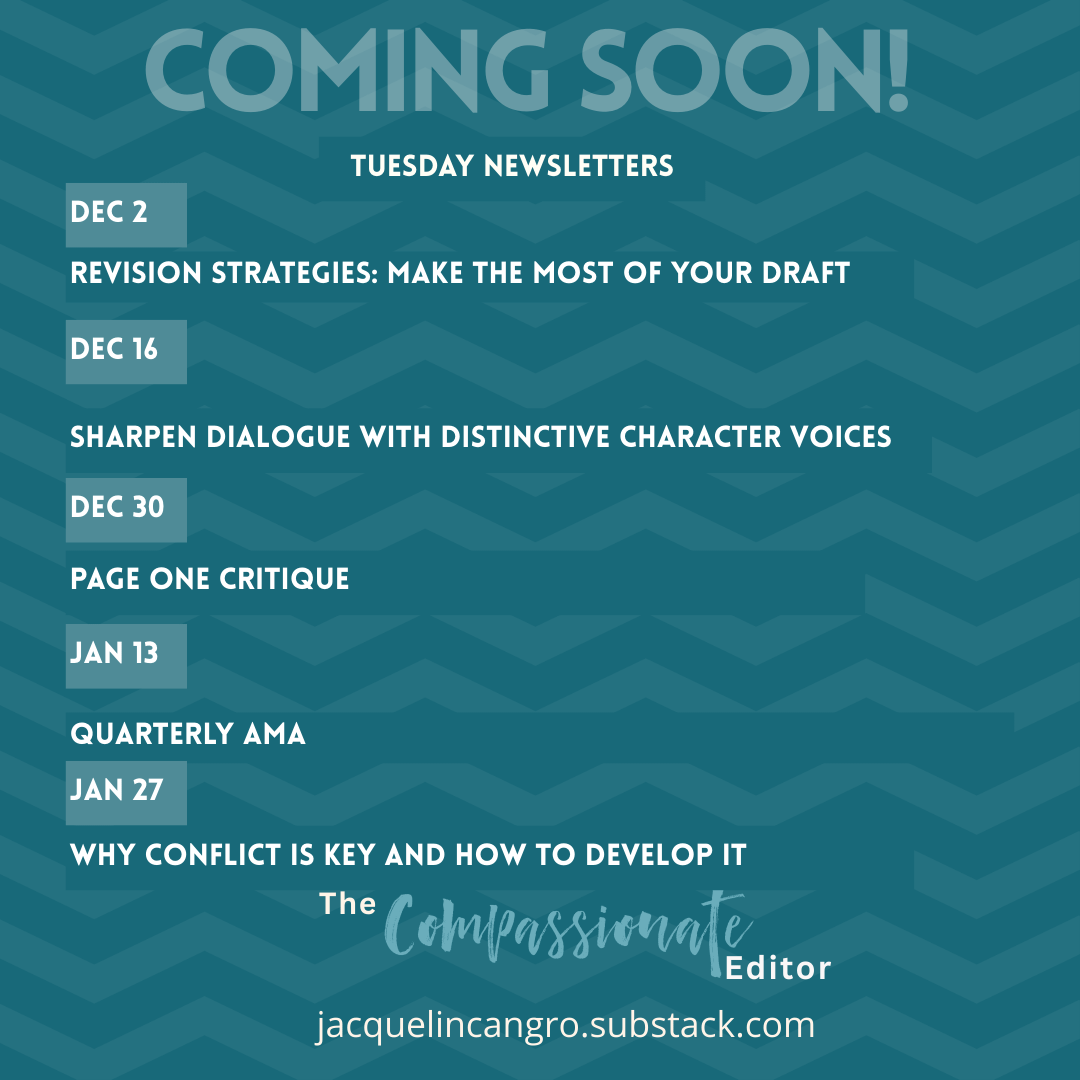
P.S. I’ll be teaching some terrific classes in the next few months. Scroll down for more details and to see what’s coming next for the newsletter!

📚 What I’m reading:
I finished Tilt by Emma Pattee (whew!), and now I need something much lighter! Enter Jenny Bayliss, the queen of Christmas rom-coms. The small-town holiday cheer in I’ll Be Home for Christmas is a perfect light-hearted and charming read.
🎥 What I’m watching:
I’ve got the third installment of the Knives Out series queued up. I’ve heard it’s the best one yet.
🎄What I’m looking forward to:
The week between Christmas and New Year’s is always a bit magical for me — a little quieter, a little calmer. The inbox doesn’t ping as much, and I’m happy to be less connected for a few days.

Upcoming Classes
Love Story Generator (Free!)
February 13, 2026, 6-7pm Eastern
This Valentine’s Day Eve, write a new love story. Whether you’re brand new to creative writing or simply in search of a spark, this Free Love Story Generator is the perfect way to court your imagination. In this one-hour session, you’ll respond to generative, love-themed writing prompts, flirt with new story ideas, and connect with other writers in a supportive, inspiring environment. You’ll leave with the seeds of a new love story and information about upcoming workshops and events to help you continue developing your writing and creative goals.
Jumpstart Your Romance Novel
Six weeks, starting February 23, 2026 from 6-9pm Eastern
If you love stories that make you swoon and want to write your own romance novel, this course is for you. Whether you have the germ of an idea or are already well into a draft, you’ll discover what makes a page-turning, heartfelt romance novel by drawing on popular examples of the genre, identifying the rules of romantic fiction and highlighting key techniques that you can bring to your own writing. In-class exercises and generative writing prompts will connect our lessons, and we’ll wrap up each week with a writing assignment and feedback on your work.
The Compassionate Editor Newsletter is a reader-supported publication. To support my work, consider becoming a free or paid subscriber. Paid subscribers have access to page critiques, AMAs and unlimited write-ins.