

How to Know When to Stop Researching
Author Shannon Terry Wiley discusses the move from research mode to writing mode

As a developmental editor, I’ve worked with authors in all phases of their career in nearly every genre. In this occasional series, I’m sitting down with an author to talk about their approach to writing, editing, and publishing.
When you’re writing an historical novel, how much research is enough? Today’s guest knew she needed to keep digging into primary source material—through diaries, journals, maps, and newspaper clippings—until she found her main characters who would shape the story.
Shannon Terry Wiley, author of Yellow September, takes readers on the journey of an epidemic, this one in 1873 which ravaged the town of Shreveport, Louisiana less than ten years after the end of the Civil War. In our Q&A, Shannon shares how researching one epidemic led her to unearth another and why she wants you to feel hopeful after reading her book.

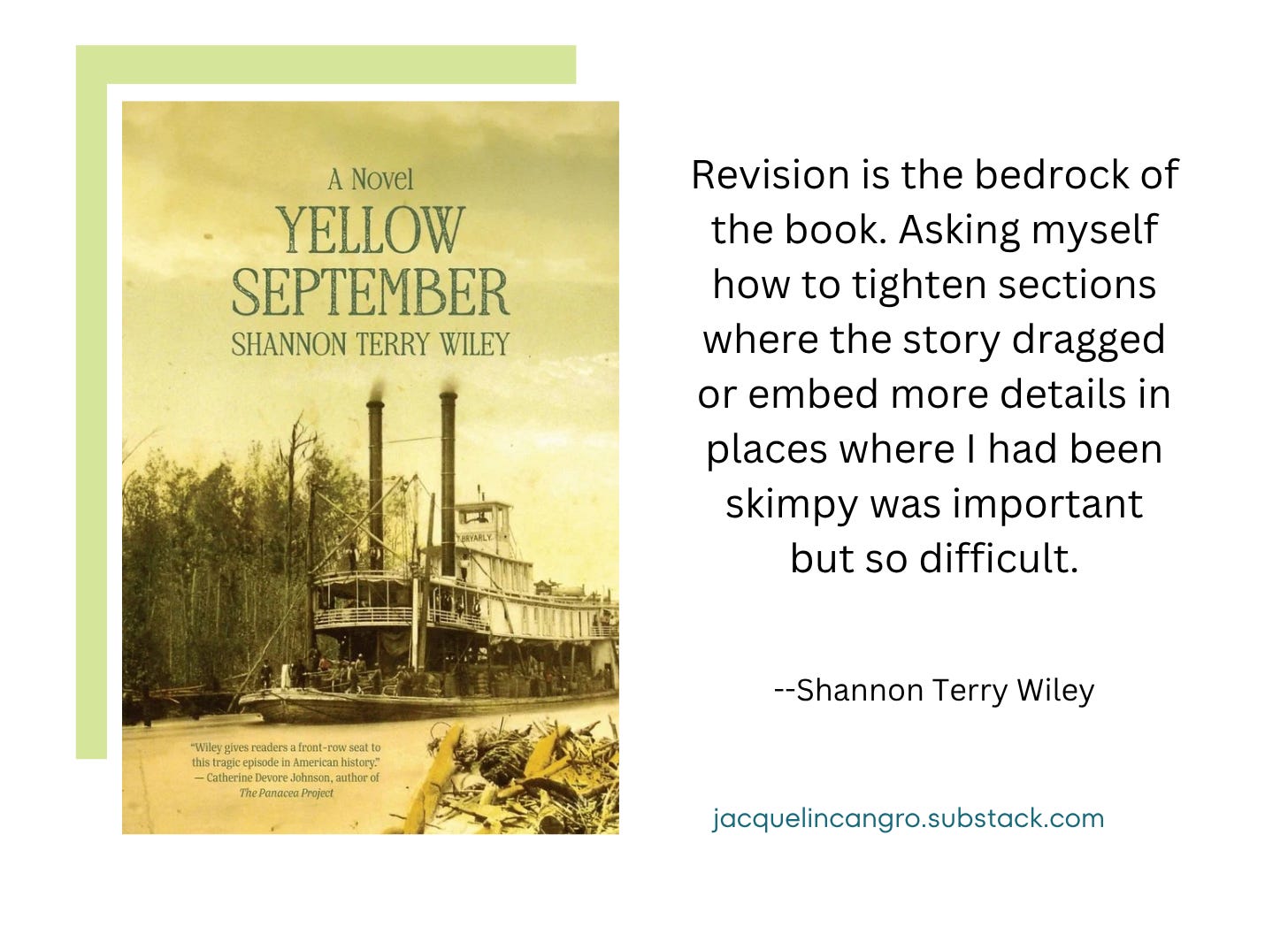
Jackie Cangro: Congratulations on your debut novel, Yellow September! What first drew you to the 1873 yellow fever outbreak in Shreveport as the setting for your debut novel, and how did you first encounter this chapter of history?
Shannon Terry Wiley: Actually, I was interested in learning about the diphtheria epidemic here that my grandmother, Pinkie, used to tell me about when I was growing up. She had been born in Shreveport in 1902 and often told me about that epidemic which had happened when she was a little girl. She had lost two siblings to the disease. So I began to look for information about diphtheria and was soon overwhelmed instead with articles about Shreveport’s yellow fever epidemic of 1873. Even though I had grown up here, I never knew about the tragedy the city had experienced in the fall of 1873. Shreveport lost a quarter of its population that September from an illness that struck with such ferocity that for nearly half of the patients who contracted it proved fatal.
JC: Can you describe your research process for this novel? What types of primary or secondary sources were most helpful, and were there any discoveries that significantly shaped the direction of the story?
STW: I started with contacting a local professor at LSU Shreveport; he was an excellent source of historical books about yellow fever. I read those he recommended and began to get an understanding of the disease and its rampage through Southern cities. Then I began to research at LSUS Northwest Archives. The excellent library staff welcomed me for many an afternoon as I poured through diaries and journals and maps and old newspaper clippings. I had no idea what the story would be, but I knew that yellow fever was the antagonist.
With all my research, notebook after notebook filled, I was able to move toward establishing the story itself. That is not to say I didn’t continue researching as parts of the book demanded more details than my initial dig had produced. The biggest discovery for me that shaped the story was the two Army Corps of Engineer brothers, Eugene and George Woodruff, who had been sent to Shreveport in 1872 to open up the Red River. When I read their notes and letters, I knew I had found two of my leading characters.
JC: The novel unfolds through multiple points of view and includes epistolary elements. How did you manage the structure of the book, and what did these different narrative approaches allow you to explore that a single perspective might not have?
STW: Oddly, I did not write the book in any order! Fairly early on, I knew the beginning and the ending. The middle was the problem! So I selected the characters who would have their own chapters and figured out their story arcs and then came the massive job of moving individual chapters into a manner that made logical sense. Happily, I am blessed with an amazing son who would get texts from me that said, “move George 2 to after Katherine 3,” and he would! This adding, deleting and rearranging was months of work. The process of adding new chapters with new characters and also working for a cohesive story was like doing a jigsaw puzzle without the picture on the box!
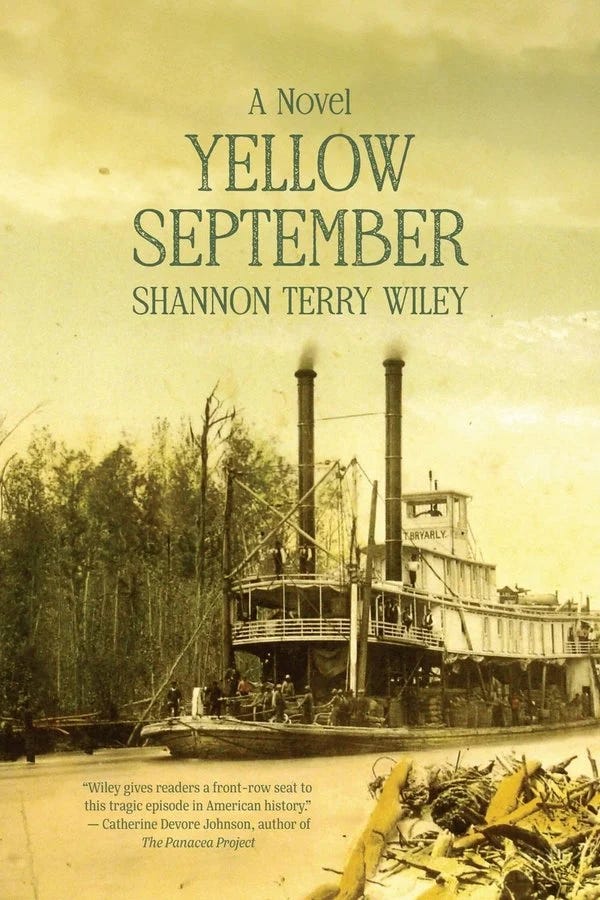
JC: I like to say that revision is often where a book truly takes shape. How did Yellow September change during revision, and were there any particularly difficult choices you had to make about what to cut, reshape, or deepen?
STW: Revision is the bedrock of the book. Hiring a developmental editor, Jackie Cangro, was the smartest choice for me. I had a few beta readers whom I trusted, but they said little more than, “I like it! Great story!” I needed an objective reader to help me look for holes and issues that my weary eyes could not find. I think the saying “Kill your Darlings,” often attributed to Faulkner, was a key to my revision. I didn’t really need to murder any character, but some got set aside while others gained more traction.
Asking myself how to tighten sections where the story dragged or embed more details in places where I had been skimpy was important but so difficult. It, of course, involved more texts to my son about shifting chapters in the novel. What I also found important was an actual printing of the book and a red pen. I was a high school English teacher for over 30 years so I found the physical text to be a comforting part of the editing.
JC: As a debut author, what do you hope readers take away from Yellow September, both in terms of its historical context and its themes of family, duty, and community?
STW: I hope that readers find the story of Yellow September to be one of hope. Even in times of uncertainty and fear, a community can stand together to fight for and aid each other. I wrote this novel during Covid, and writing about an epidemic during an epidemic was a weird experience. I could relate to the fear of the unknown my characters and the people of Shreveport must have felt during that terrible time.
The choices one makes, even coming from a place of love, can have unintended consequences. Katherine Rafferty, the central character in my novel, makes choices that send her life in an unexpected direction. Yet she takes one step at a time, choosing bravely, a life she had not imagined.
JC: What did writing this book teach you about your own creative process, and how do you think that experience will influence the stories you tell in the future?
STW: I learned a lot about myself during this process. I have a sharper mind in the morning! I can get so caught up in the fiction that it lives inside my head, like a movie that is playing. Elizabeth Gilbert calls that experience “ Big Magic,” and I completely agree. I think having a dedicated space and time for writing also helps me be consistent.
I learned that the hardest part of writing for me is the thinking. I spent so many hours thinking aloud about the “what if’s” and jotting down the possibilities these answers revealed. Once I had thought through the issue I wanted to solve, like how do I get this character to know this person or that, I often could write the scene in a flash. My next book is well underway and I am finding spurts of the Big Magic again, thankfully!
Shannon Terry Wiley is a Louisiana native with deep roots in Southern storytelling. She earned her English degree from LSU and an MA in Creative Writing from Sam Houston State University. After more than thirty years as a high school English teacher, she now brings her love of history and place to the page. When she’s not writing, Shannon enjoys reading on the porch, fishing Louisiana backwaters, spoiling her rescue pup, Dante—and her grandchildren, Waylon and Mae. This is her debut novel.
You can find YELLOW SEPTEMBER through Bookshop.org, Barnes & Noble and Amazon.

The Compassionate Editor Newsletter is a reader-supported publication. To support my work, consider becoming a free or paid subscriber. Paid subscribers have access to page critiques, AMAs and unlimited write-ins.
Upcoming Classes
The Happily Ever After Reading Group
six weeks starting July 23 from 6-7:30pm Eastern
Surrender to the pull of passion in this online romance book club, where three unforgettable love stories await to sweep you completely off your feet. From slow burns to second chances, we’ll read unforgettable chemistry and all the swoony moments your heart can handle. Join fellow romance lovers for lively chats, flirty fun, and six weeks of pure bookish bliss!
Together, we’ll explore two big themes at the heart of every great love story: vulnerability and self-discovery. What does it truly mean to risk your heart—and how do love and loss shape who we become? Through thoughtful conversation, we’ll unpack how our characters grow, what wholehearted love looks like on the page, and why the best romances leave us changed long after the HEA.
READING LIST:
One & Only by Maurene Goo
The Paris Match by Kate Clayborn
All the Feels by Olivia Dade
Be Your Own Developmental Editor
Saturday, August 1 from 10am-1pm CENTRAL
This class will provide the tools and techniques to help you see your manuscript the way an editor or agent might see it. We’ll ask the tough questions to guide you in making your manuscript the best it can be. You’ll use these tools to assess your story’s strengths and weaknesses. Whether your goal is self-publication or securing an agent, you’ll learn what marks your manuscript as the work of a professional.
Together we’ll look at some big picture, story level aspects of your book, then we’ll review the sentence level for things like redundancies and filter words. I’ll give you ways to approach your manuscript, both systematic and strategic, so you can effectively edit. We’ll have in-class exercises and lessons to help you get off to a great start. This class would be a good fit for writers who have completed the first draft of a novel or memoir.